Website design for electricians, built around the jobs people search by name.
Nothing to pay before launch. The build costs $0, then $297 a month including GST once the site is live and tracking is verified, which is $3,564 in total.
What does an electrician's website need to bring in work?
The certificate is part of what you sell, and people search for it by name.
Electrical work in this country arrives with paperwork attached. Once a licensed electrician finishes, the customer is owed a compliance document for the work, and that document is called something different in every state: a Certificate of Electrical Safety in Victoria, a Certificate of Compliance for Electrical Work in New South Wales, a Certificate of Compliance in South Australia. Those exact phrases get typed into Google, usually by somebody who has just been asked for one by a conveyancer, an insurer, a property manager or a building surveyor, and who does not have it.
That search has a deadline sitting behind it, and hardly any electrician has built a page for it. The person typing it is not collecting quotes. They need somebody licensed to attend, test and issue the document before a settlement or an inspection. The same goes for everything that creates the demand: a rental due for its scheduled safety check, smoke alarm obligations on a lease, a defect notice from the distributor, a safety switch that has to be in before a house changes hands. Those are dates, not whims.
Your licence number belongs on the site as selectable text, in the footer and beside the enquiry form. Homeowners do check it against the state register before letting anyone through the door, and a number baked into a logo image cannot be copied and cannot be read by a search engine.
Hardly anyone searches for a switchboard upgrade. They search for what went wrong.
The customer who needs a new board does not know that yet. What they know is that the power keeps tripping when the kettle and the heater run together, or that the thing on the laundry wall still holds ceramic fuses and fuse wire, or that a solar installer has told them the board will not take another circuit. So they type: power keeps tripping, half the house has no power, old fuse box, burning smell from a powerpoint. The trade term and the customer's words describe the same job, and only one of them is being typed.
The page has to carry both. Put the customer's language in the heading and let the body do the correct terminology, so it can be found by somebody searching for a safety switch that will not reset while still reading as the work of a person who knows what an RCD does. Then say what genuinely moves the price: single phase or 3 phase, how many circuits, the state of the meter box, whether the backing board contains asbestos. Naming those removes the argument at quote stage.
Safety switch installs are small jobs and worth taking anyway. They are usually forced by a sale, a lease or an insurer rather than chosen, and the sparky who turns up for the compliance job is the one who gets rung about the rewire later.
EV charger installation is a whole search set that nobody local has claimed.
The EV charger query family barely existed a few years ago and it grows on its own, which makes it the rare local search where the competition is still thin. The buyer almost always arrives before the car does. They have ordered a vehicle, delivery is weeks away, and they are using that time to work out what has to happen at home. That is a research window, and it rewards a page that answers questions instead of one that says I install EV chargers and gives a phone number.
The questions barely vary. Will the existing switchboard carry it. Is the house single phase or 3 phase. How far is the cable run from the board to the garage. Does load management need to go in so the oven and the charger stop fighting. Does the network distributor have to approve the load first. Answer those in writing and you become the electrician they ring, because you treated the enquiry as a decision rather than a lead.
People also search by model, because the charger was usually chosen alongside the car, so list the units you install and the ones you will not touch. Apartment and strata installs are a harder and better paid version of the same job and need their own page, because the buyer there is a committee rather than a homeowner with a driveway. Rebates move around, so date anything that mentions one.
Solar and battery work touches yours, and the repairs are unclaimed.
New solar installs are fought over by national retailers running budgets you cannot match, and rebate-eligible installs need the relevant accreditation, so there is no sense chasing a search you cannot legally service. If you do not hold it, put that on the page. A clear line about what you do not do saves more phone time than another paragraph about what you do.
The part nobody wants is the part worth having. Systems go dead and stay dead for months because the owner does not know who to call. Inverters throw fault codes and the original installer has folded. Isolators fail in the weather. A re-roof means every panel comes off and goes back on, with a roofer waiting. Somebody wants a battery added to an array installed by a company that no longer exists.
Those searches read like faults rather than services: solar not working, inverter error code, solar panel removal for roof replacement, adding a battery to existing solar. Volume on each is small. Intent is close to total, competition is close to none, and the owner has already paid for the system, so the job is rarely a haggle. Name each page the way the fault gets typed.
A facilities manager and a homeowner should not land on the same page.
The homeowner is deciding whether to let a stranger into the house while nobody is home. Licence, trust, punctuality, drop sheets and a price they can picture decide it. The commercial buyer is a facilities manager, a builder, a shopfitter, a strata manager or a venue owner, and none of that language moves them at all. They need to know you can attend when the site is shut, that your public liability certificate and safe work method statements can be sent the same day, and that you will invoice on account.
The searches split just as hard: test and tag, RCD testing, exit and emergency light testing, thermal imaging on a switchboard, 3 phase fault finding, data cabling, shop fitout electrical, scheduled switchboard maintenance. In New South Wales, Level 2 accredited service provider work covering service mains, metering and reconnections is a separate accreditation with its own searches again. None of those words appear on the average electrician's website, because that site was written entirely for the homeowner.
The fix is not a longer homepage. It is a commercial section with its own pages, its own proof and its own enquiry path, including a form that asks for a site address and access hours rather than a suburb. Recurring compliance testing is contracted work, the steadiest revenue an electrical business can have, and it gets won by looking organised in writing.
The 11pm call and the job that pays for the ute are different customers.
Fault calls behave a lot like a burst pipe. The power is out, the searching is frantic, and the first sparky who picks up wins it. What is not the same is the invoice at the end. A tripped circuit found and reset is a small job, while the switchboard, the charger, the rewire and the maintenance contract are where the year gets made. A site built entirely around the emergency search optimises for your least profitable work.
The fault call
- Searched at speed, often after dark, on mobile data
- Won by answering the phone, not by owning every keyword
- Small average invoice, high nuisance value
- Builds the relationship, and the review if you ask for it
- A share of no-power calls are network outages you cannot bill
The planned job
- Researched over days or weeks, usually on a laptop
- Won by the page that answers the questions properly
- Switchboards, EV chargers, rewires, solar service, contracts
- The customer reads 2 or 3 electricians before ringing one
- Where the margin and the repeat work actually live
The single most useful line on an emergency page is the one that tells people to check their distributor outage map before they ring you. It costs a handful of callouts you were never going to bill, and it buys you a reputation as the electrician who did not charge somebody to be told the whole street was out.
If your website has not produced a lead from SEO within the first 90 days, you stop paying me until it does. There is no refund, and I do not promise rankings.
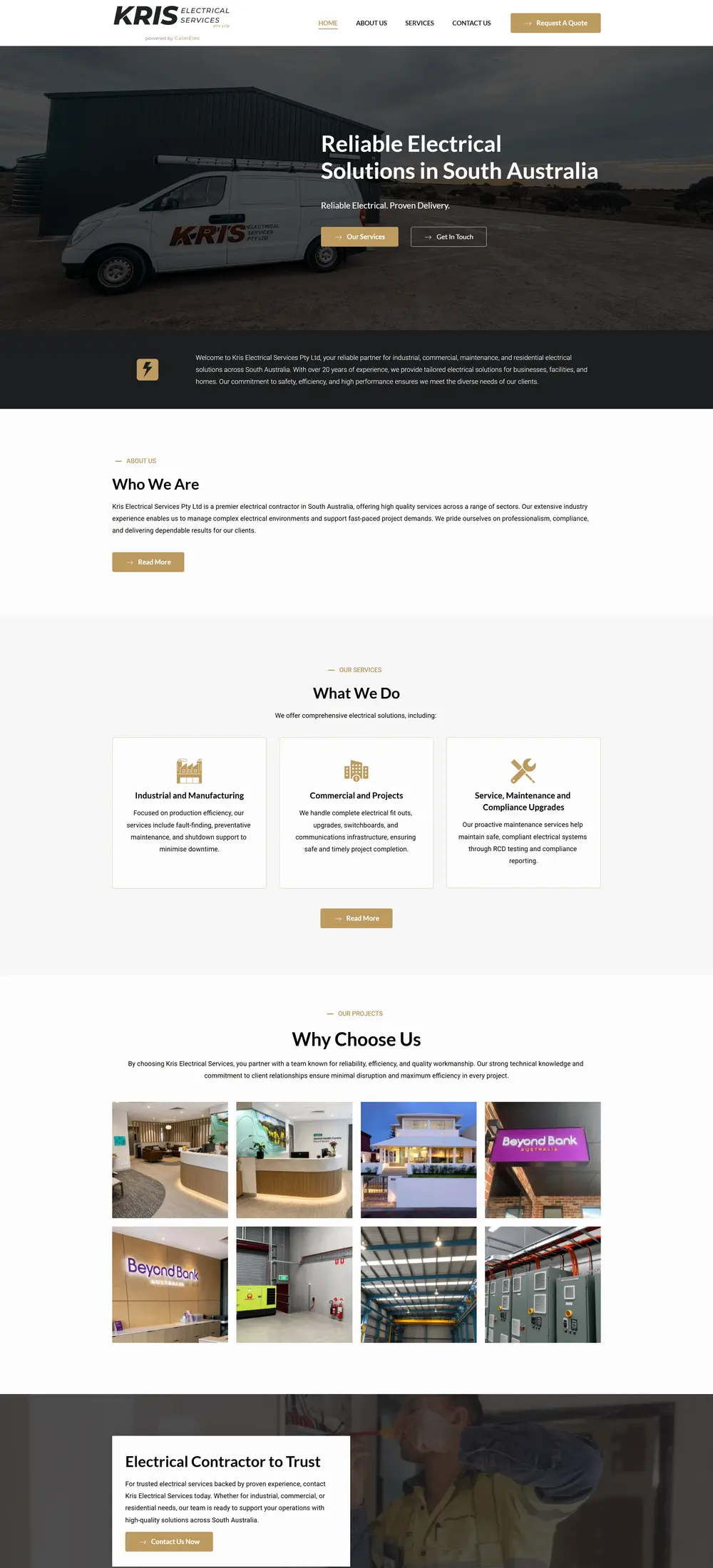
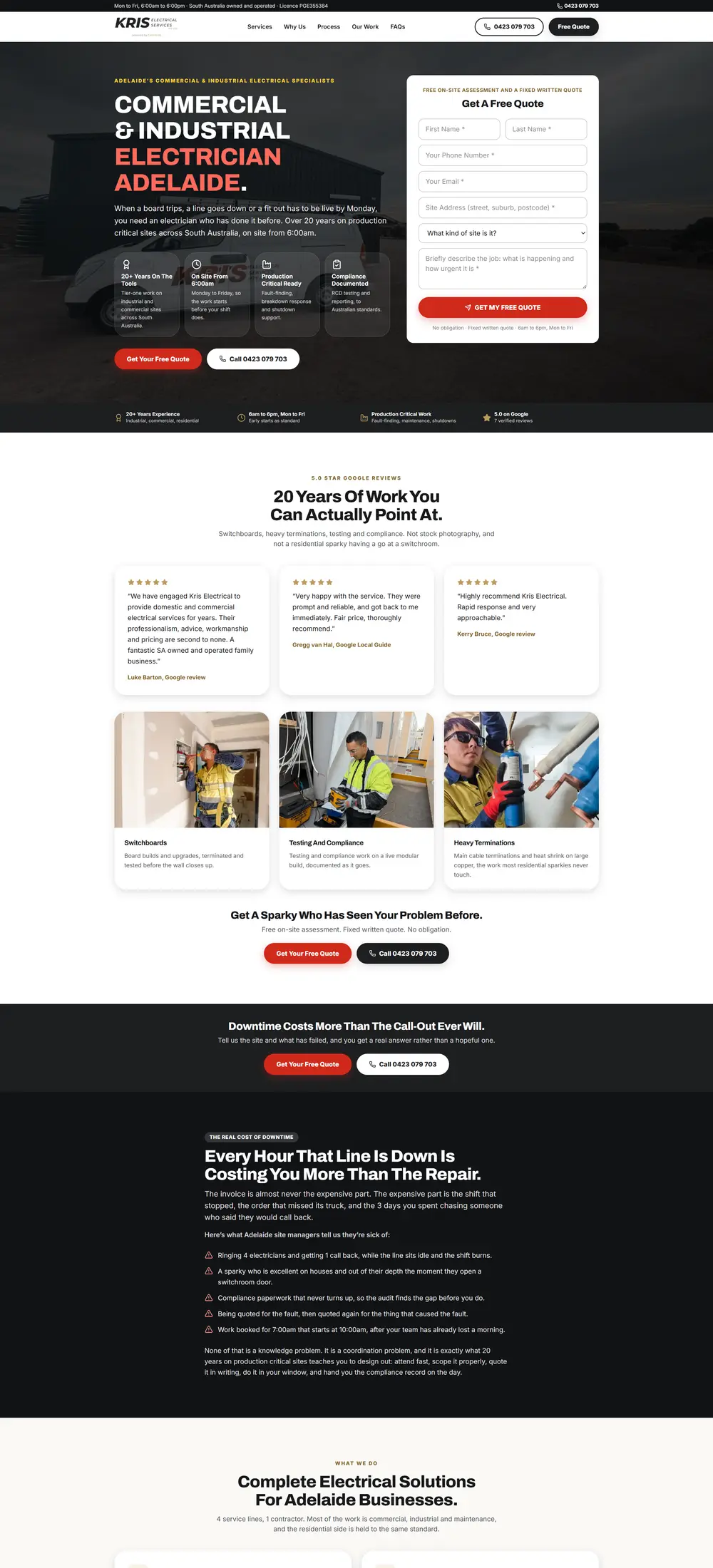
Read the full termsKris Electrical Services is live on this offer, alongside these trades.
Kris Electrical Services, a commercial, industrial and residential electrical contractor in Adelaide, went live on this offer on 9 September 2026, and its card leads the wall, followed by trades with the same buying pattern: licensed, callout-driven and quoted job by job. Under each card, in monospace, sits the title tag that site serves right now.
Not just prettier. Built to be found.
Every rebuild leads with the client's main commercial keyword in the page title and a single clean H1. Design that looks the part, architecture that ranks on Google.
1 plan. $0 to start. Yours to keep.
The $297/month subscription is the all-inclusive monthly retainer that keeps your site working long after the build is done. Hosting, backups, and any website changes you need (swap an image, edit some copy, add a page), with a direct line to Chris. First payment only triggers once the site is live and tracking is confirmed.
The site, the domain and the code belong to you from day 1. After the 12th payment your website is paid off, and you choose: keep your plan at $297 a month for website changes and a quarterly SEO review, or cancel, and I'll either keep hosting your site for free or hand you the full code to host wherever you like.
- Free website, built in 5 working days
- No leads from SEO in your first 90 days and you stop paying until one arrives.
- Built SEO-ready: keyword-aligned pages, schema, fast hosting
- Hosting served from Sydney, with daily backups
- Ongoing website changes: swap an image, edit copy, add a page
- Client portal: request changes, made within 3 business days
- A direct line to Chris and a single point of contact
- Paid for in full by 12 payments, then it's yours to keep
- Google Ads management available as an add-on
What a website really costs, and who should build it.
What electricians ask before they send the licence details.
Nothing forces you to, but leaving it off costs work. Homeowners check numbers against the state register before letting anyone inside. Put it in the footer, on the about page and beside the enquiry form, as text rather than inside a logo image.
Symptoms first, services later. Power keeps tripping, half the house has no power, old fuse box, burning smell from a powerpoint. The job names come afterwards: switchboard upgrade, safety switch install, EV charger installation, smoke alarm compliance. A site built only on trade terms misses the first half.
Yes, and it is one of the few local searches still barely contested. Buyers research for weeks while they wait on delivery, and they all ask about phases, switchboard capacity, cable runs and load management. The page that answers those tends to get the call.
Yes, but aim it at service work rather than competing with national retailers on new installs. Dead systems, inverter faults, failed isolators, panel removal for a re-roof and batteries added to old arrays are searched by owners who are stuck and cannot find anyone.
Give commercial its own pages and its own vocabulary: test and tag, RCD testing, emergency light testing, thermal imaging, scheduled maintenance. Then publish what a facilities manager checks before engaging anybody, which is insurance, safe work method statements, after-hours availability and account invoicing.
Worth ranking for, not worth building the whole site around. Fault calls carry small invoices, and some no-power calls turn out to be street outages. Publish your after-hours rate and point people at the distributor outage map to cut the unbillable ones.
I draft it and you correct it before anything goes live. Nothing about compliance, certificates or scope of work gets published until you have read it, because a wrong claim on an electrical page is a licensing problem for you, not a typo for me.
No, and treat anyone who promises that as a warning sign. Named proof is what I offer instead: sydney-underpinning.com.au reached the top 3 for its main search term, and Adelaide's Bathroom Network started showing up inside 8 weeks of launch.
Electricians: 3 of this month's 4 build slots are still open.
Send me your licence number, the areas you genuinely drive to, and the work you want more of: switchboards, EV chargers, solar service calls or commercial testing. I reply in writing with a proposal, and everything after that runs by email and through the client portal.