Website design for plumbers, built for the 11pm burst pipe and the fortnight-long hot water decision.
Nothing to pay before your site is live. After launch it is $297 a month including GST for 12 months, $3,564 all up, and the first invoice only goes out once the site is live and tracking is verified.
What does a plumber's website actually need?
The 11pm burst pipe is a mobile search and it is over in 90 seconds.
Most plumbing enquiries do not begin with research. They begin with a noise. Water coming through a downlight, a cistern that will not stop filling, a smell in the laundry at 11pm. Whoever is searching has already found the mains tap, they are holding a phone with wet hands, and they are on mobile data because nobody thinks about the wifi password while the ceiling is dripping. They will open 2 or 3 results. The one that loads and shows a number gets the job.
That sets a hard specification before anybody talks about design. The number belongs in the header as a tap-to-call link on every page, as text rather than sitting inside an image. The emergency page has to render on a patchy 4G connection in a hallway, which rules out a hero slideshow loading ahead of the phone number. If a form gets used at all at that hour, it asks 4 things: name, number, suburb, and what is happening right now.
The honest part matters more than the layout. If you pick up at 2am, say so and publish what the after-hours rate is. If you stop at 6pm and start again at 7am, publish that instead. A 24/7 badge nobody answers wins the job once, then earns a review naming the exact hour the phone rang out.
A burst pipe, a blocked drain and a cold shower are 3 different searches.
Plumbing is unusual in that one licence covers jobs with wildly different levels of panic, and the customer types a different phrase for each. Google matches a phrase to a page rather than to a business, so a single services page listing everything competes for everything and wins none of it.
Burst pipes and leaks
Searched at night, on weekends and on public holidays, on a phone, by somebody who has already shut the water off. Their only question is who answers. Put the callout fee, the after-hours rate and the suburbs you can genuinely reach quickly on that page and you stop fielding calls you were never going to take.
Blocked drains
This blockage has usually been cleared before. They want it diagnosed rather than cleared again, so they search for a jetter and a drain camera by name, and for somebody who will tell them whether it is tree roots in the sewer or a collapsed line. What a CCTV drain inspection costs is a search in its own right.
No hot water
Nobody rings at midnight over a cold shower. They ring in the morning, having already read whether a 12 year old unit is worth repairing. Answer the repair question straight on that page, because the half who do need a replacement will remember that you did not immediately try to sell them one.
Renovation and rough-in
Often arranged through a builder or a bathroom company, and compared against 2 other quotes. The worry here is not price, it is whether you turn up on the day the tiler is booked. Say how you schedule around other trades, and show a bathroom you actually plumbed rather than a stock render.
Give each of those its own URL, its own title tag and its own vocabulary. That is why Miller's Plumbing Services has landing points for emergency work, hot water and bathroom plumbing rather than one page called Services.
Hot water replacement is the plumbing job people research for weeks.
Nearly every other plumbing search is reactive. Hot water is the exception, and it behaves like a retail purchase. A unit that is 12 years old starts running cold once 2 people shower back to back, nothing has technically failed yet, and the household spends a fortnight reading before anybody picks up the phone. Through that fortnight they are searching brand names rather than plumbers: Rheem, Rinnai, Bosch, Dux, Aquamax, and more and more often heat pump against gas continuous flow.
They search sizing too, because no homeowner knows what they need. How many litres suits a family of 5, whether a continuous flow unit can run off the existing gas line, what a tempering valve does, whether an electric storage tank can be swapped for a heat pump in the same footprint and the same afternoon. Those questions decide the job, and the plumber who answers them in writing is the plumber who gets rung.
So the hot water page names the brands you install and service, explains storage against continuous flow against heat pump in the words a homeowner would use, and states plainly whether a same-day changeover is possible. Rebates and incentives shift and differ by state, so I write that part to be edited through the client portal rather than baked into an image. It is also the one genuinely informational page a plumbing site publishes, which makes it the page most likely to earn a link.
Gas work is bought on a licence number, so publish it as text.
Gas fitting is licensed separately from general plumbing in every Australian state, and the person checking your credentials is frequently not the homeowner. It is a property manager arranging a compliance check, a landlord who has been told an unflued heater needs testing, an agent who needs the certificate before settlement, or somebody who smelled gas near the meter and is now reading your page very carefully indeed.
That reader has a specific habit: they copy the licence number and paste it into their state register. If your number lives inside a logo image or halfway down a PDF, they cannot copy it, and the check ends quietly with them ringing somebody else. The plumbing licence and the gas fitting authorisation belong in the footer, on the about page and beside the enquiry form, as selectable text, with the state that issued them.
Gas jobs that get searched by name
- Gas cooktop, oven and heater installation
- Gas leak detection and meter work
- LPG to natural gas conversions
- Unflued heater servicing and carbon monoxide testing
- Gas hot water, pool and spa heating
- Compliance certificates at handover
Say which of those you take and which you refuse. I am not a licensing authority and none of this is legal advice, so the wording stays inside what your own licence covers, and you check it against your state's rules before it goes live.
No trade depends on the map pack the way plumbing does.
Search for an emergency plumber and 3 businesses appear above everything else with a Call button attached to each. Somebody watching water come out of a light fitting taps one of those buttons. They do not scroll to the blue links and they never reach an about page. That gives a plumbing website a second job most trades do not have: it has to make the profile rank, not only rank itself.
The 2 assets get read together. Where the profile lists blocked drains, gas fitting and hot water as services, each one needs a page behind it saying the same thing in more detail, under the same business name, the same number and the same service area. Any disagreement between them weakens the profile. Reviews carry it further when they name the job and the suburb, which is something you can ask a customer for and I cannot write for you.
Opening hours are the other half of it. The pack prints Closed beside your name at 9pm, which is precisely when the emergency searching happens, and the plumbers marked open take those calls. If you do take after-hours work, set the hours to match and back them with an emergency page. If you do not, the site still catches everything the pack never shows: brand and model hot water queries, cost questions, and the bathroom research that runs for weeks before anyone rings a plumber.
Plumbing enquiries arrive as phone calls, so I count phone calls.
A form submission records itself. A ring at 7:40pm does not, and in this trade that ring is most of the work. Every build carries call tracking on the header number, so the guarantee has something to measure and you can see which search produced which job.
No leads from SEO in your first 90 days and you stop paying until one arrives.
A lead here means a first-time caller who stayed on the line for 60 seconds or longer, or somebody who completed the contact or quote form. Existing customers, suppliers, sales calls, spam, family and anything arriving from a paid ad are all excluded. There is no refund: the remedy is that billing stops until a real job comes through.
Read the full guaranteeOne plumbing build on this offer, shown on its own.
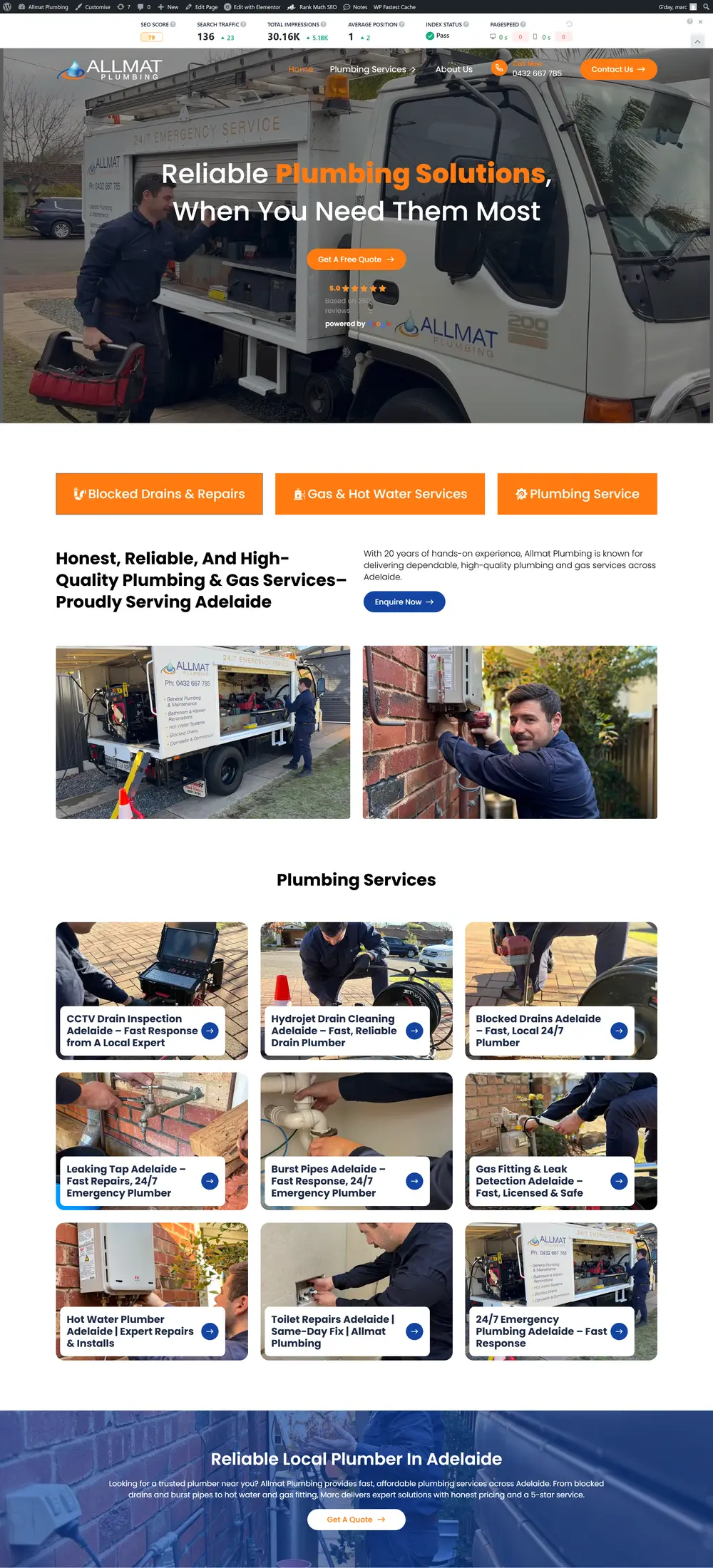
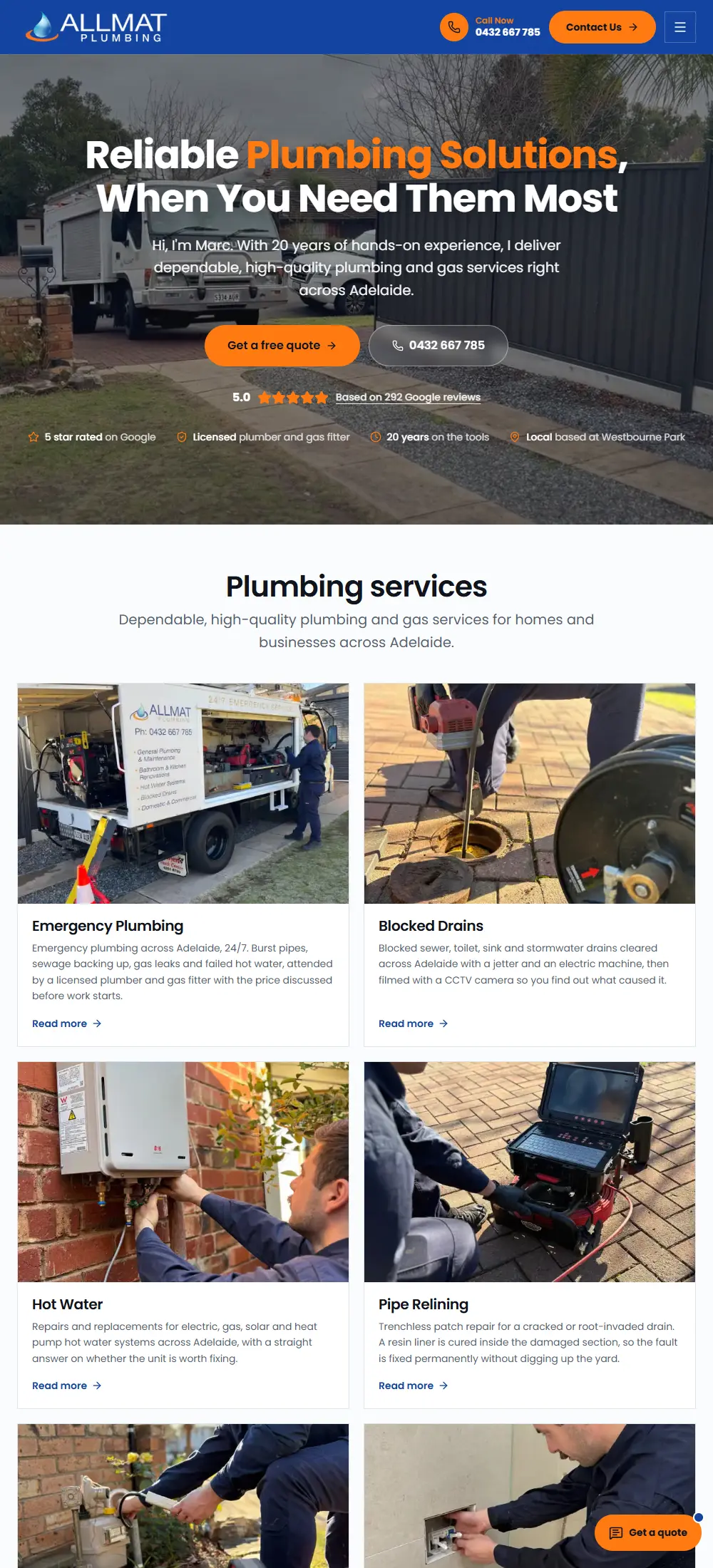
I could pad this wall out with 8 other trades to make it look busier. There is 1 plumbing and gas fitting business running on this subscription today, so here it is by itself. Open it, then read the monospace line under the card: that is the actual title tag the site serves, and you can check it against what somebody in the Adelaide Hills with no hot water would type.
Adam Plumbing and Gas was not built on this offer.
The most detailed plumbing result I can show you came from a different arrangement. Adam Plumbing and Gas in Adelaide is a full-service Loudachris Digital Marketing client on a normal paid engagement, not the $297 subscription described on this page. That build went from 13 to 41 jobs a month across 4 months. I name the plan he was on because a number is worthless if you cannot see what produced it.
The work that moved it is the work described further up this page: service pages matched to how people actually search, and a profile that agrees with the site. The commercial terms are simply not the same, and pretending otherwise would be the easiest lie on the site to tell. Read the Adam Plumbing and Gas write-up.
What an enquiry looks like by the time it reaches you.
No mystery, no portal logins. The site's contact form emails the lead straight to you in plain English. Every field a tradie or service business needs to call back the same day.
- Name, email, phone in the first three lines
- Suburb (so you know if it's in your service area)
- The exact service they want and the page they came from
- Their full message in their own words
Reply directly from your inbox. Nothing to learn, no app to install.

Not just prettier. Built to be found.
Every rebuild leads with the client's main commercial keyword in the page title and a single clean H1. Design that looks the part, architecture that ranks on Google.
1 plan. $0 to start. Yours to keep.
The $297/month subscription is the all-inclusive monthly retainer that keeps your site working long after the build is done. Hosting, backups, and any website changes you need (swap an image, edit some copy, add a page), with a direct line to Chris. First payment only triggers once the site is live and tracking is confirmed.
The site, the domain and the code belong to you from day 1. After the 12th payment your website is paid off, and you choose: keep your plan at $297 a month for website changes and a quarterly SEO review, or cancel, and I'll either keep hosting your site for free or hand you the full code to host wherever you like.
- Free website, built in 5 working days
- No leads from SEO in your first 90 days and you stop paying until one arrives.
- Built SEO-ready: keyword-aligned pages, schema, fast hosting
- Hosting served from Sydney, with daily backups
- Ongoing website changes: swap an image, edit copy, add a page
- Client portal: request changes, made within 3 business days
- A direct line to Chris and a single point of contact
- Paid for in full by 12 payments, then it's yours to keep
- Google Ads management available as an add-on
If you are still weighing up who builds it.
What plumbers ask before they hand over the licence details.
Yes, and it should be the fastest page on the site. Emergency searches happen on mobile data, after hours, from somebody who has already turned the water off. That page needs your number as a tap-to-call link, the after-hours rate, and the areas you can genuinely reach quickly.
Only if you answer at 3am. An unanswered 24/7 claim wins one job and then earns a review naming the night the phone rang out. If you take after-hours work until 10pm and start again at 6am, publish those hours and set the same ones on your Google Business Profile.
In the footer, on the about page and beside the enquiry form, as selectable text with the state that issued it. Property managers and landlords paste that number into their state register to verify it. If it only exists inside a logo image or a PDF, they cannot, and they move on.
With a blocked drain page instead of a bullet point on a services list, written about the actual job: jetting, drain cameras, tree roots, sewer against stormwater. Then list blocked drains as a service on your Google Business Profile so the profile and the page say the same thing.
They are the most valuable non-emergency traffic a plumber can attract. Somebody weighing a heat pump against gas continuous flow is a fortnight away from spending thousands of dollars, and they search by brand and by litres, not by the word plumber. Name what you install and service.
For emergency calls, the map pack sends more of them. The profile is not yours though, it can be suspended or edited by strangers, and it performs better when a real site with matching service pages sits behind it. The site also catches the research searches the pack never displays.
They look you up before adding you to a list, and a property manager checking your gas authorisation is a serious reader with a specific need. Build for them as well: licence details, insurance, response times, and the commercial and compliance work you are willing to take on.
I will not promise that, and be wary of anyone who does. Emergency terms are the most contested in the trade and they move with the map pack, not with the page alone. What I put in writing instead is this: No leads from SEO in your first 90 days and you stop paying until one arrives.
Build slots left this month: 3 of 4.
Tell me the suburbs you drive to, whether you take after-hours work, and which of blocked drains, hot water or gas fitting you want more of. I reply in writing, and everything after that runs by email and through the client portal.