Websites for landscapers, built for 2 different buyers and a season that will not wait.
The build costs you $0. Once it is live, $297 a month including GST on a 12-month subscription, which is $3,564 in total, and nothing at all before launch.
What should a landscaping or lawn care website include?
Two buyers who never meet, sharing one website.
Mowing, hedging and garden tidy-ups get bought the way a takeaway gets bought. Somebody looks at a lawn that got away from them over a wet fortnight, searches from the back step on a phone, and wants a price and a day. They have already decided to pay somebody. They are only choosing who, and the business that answers with a number wins.
Paving, retaining, irrigation, turf and full garden design is the opposite purchase. That customer saves photographs for months, talks it over at home, gathers 3 quotes written to 3 different scopes and cannot line them up against each other. The ticket is large and the decision is slow, because they are not buying a service. They are buying the backyard they keep picturing.
The maintenance buyer
- Decided already, choosing who to ring
- Wants a price, a start date and a frequency
- Compares 2 or 3 businesses, then stops
- Judges you on access, clippings and reliability
- Worth years of revenue if the round sticks
The design and construction buyer
- Undecided, still picturing the finished yard
- Wants photographs, scope and reassurance
- Collects 3 quotes that are impossible to compare
- Judges you on the last job that looked like theirs
- Worth a large single ticket and a referral street
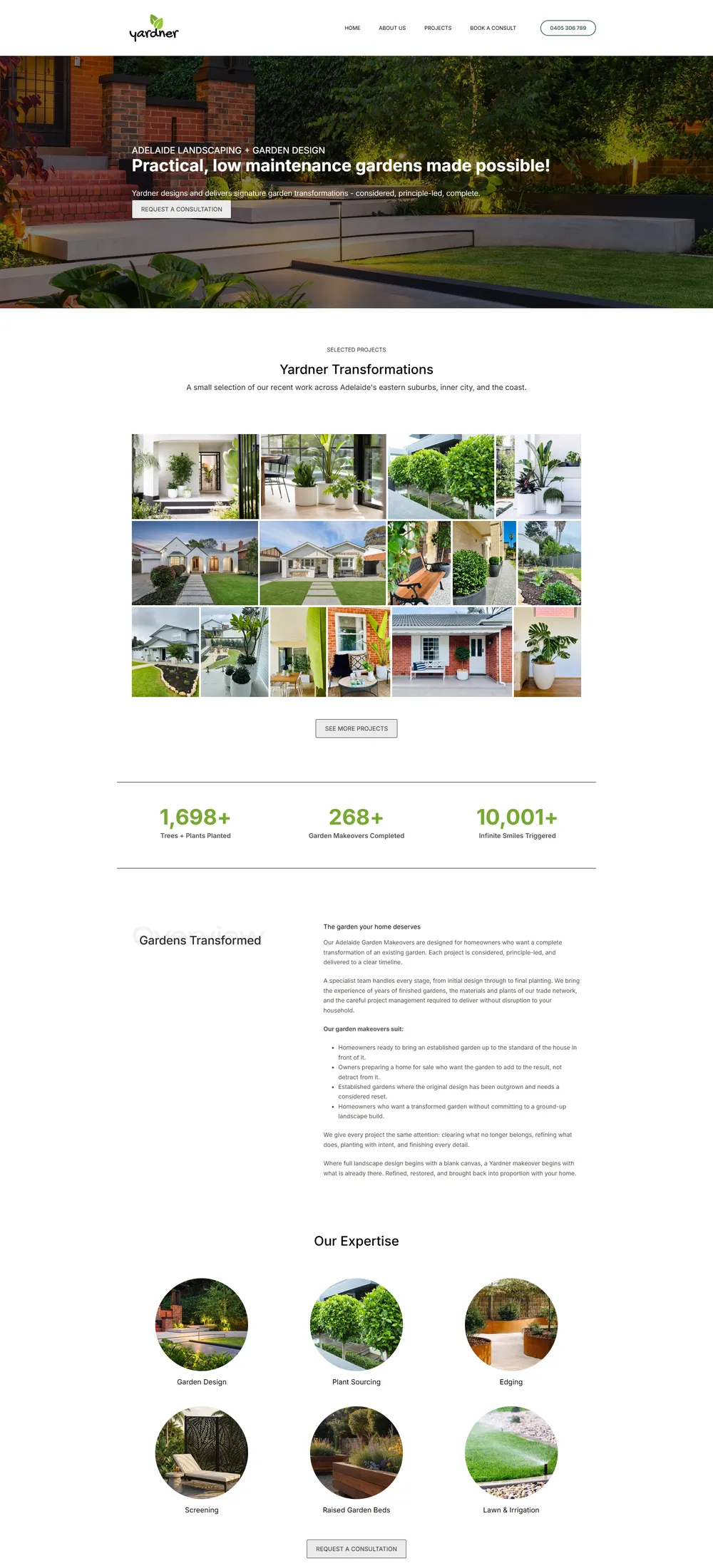
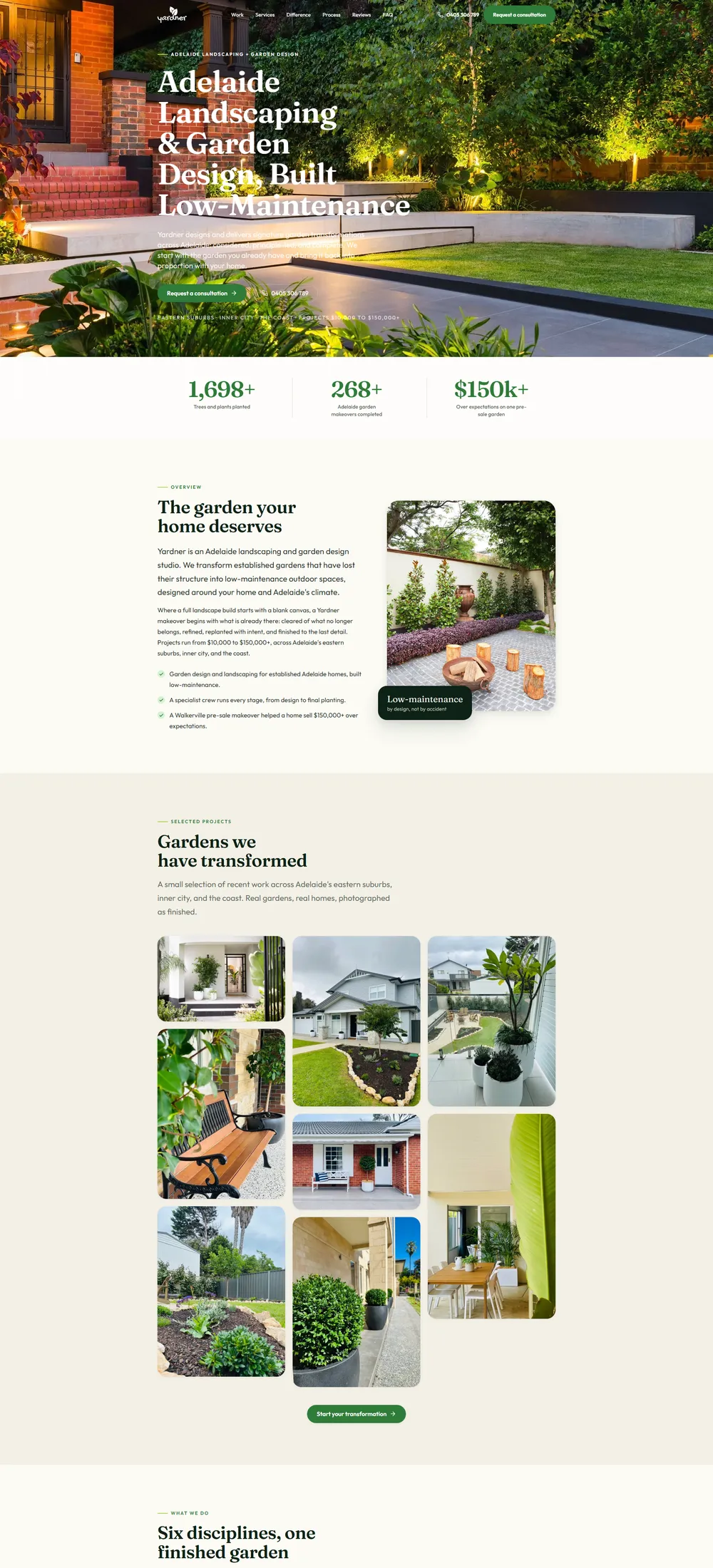
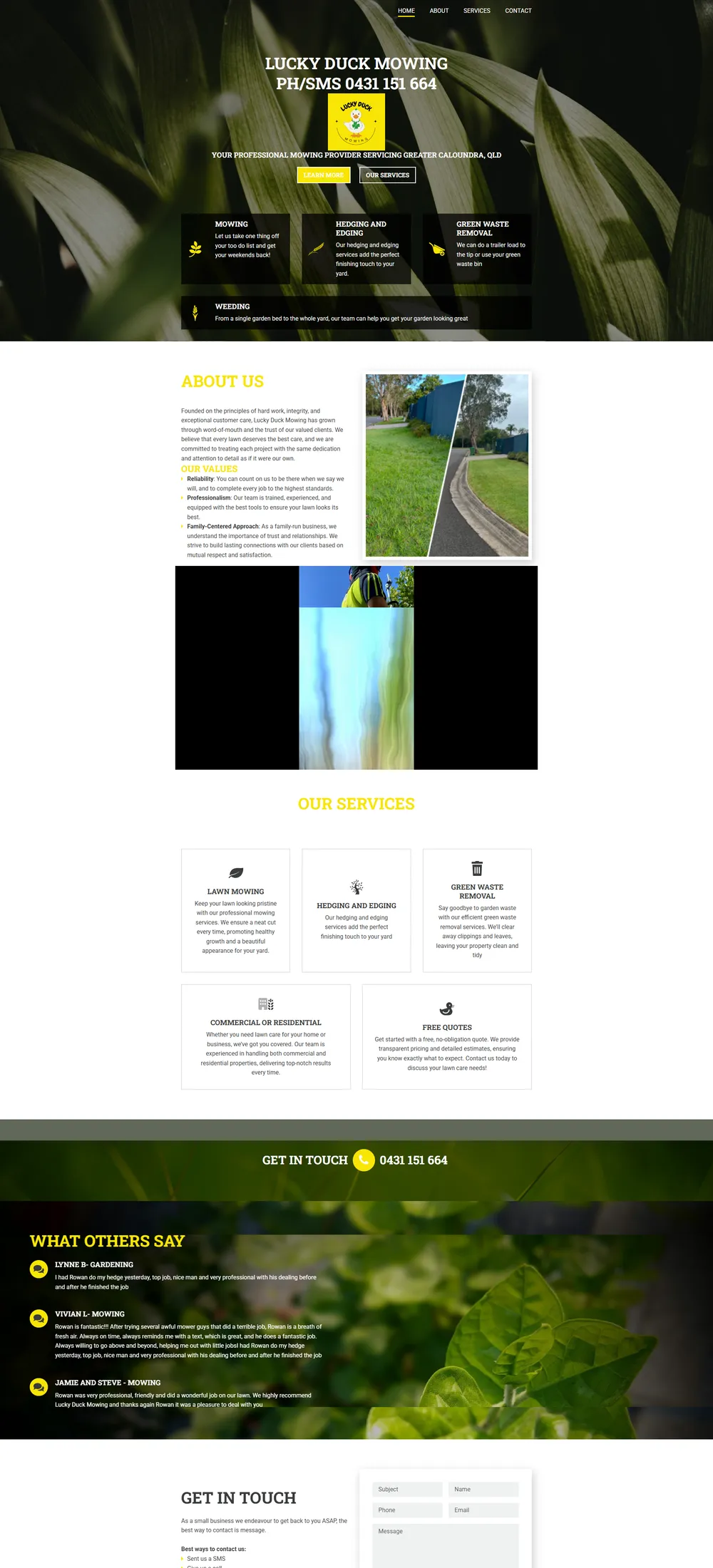
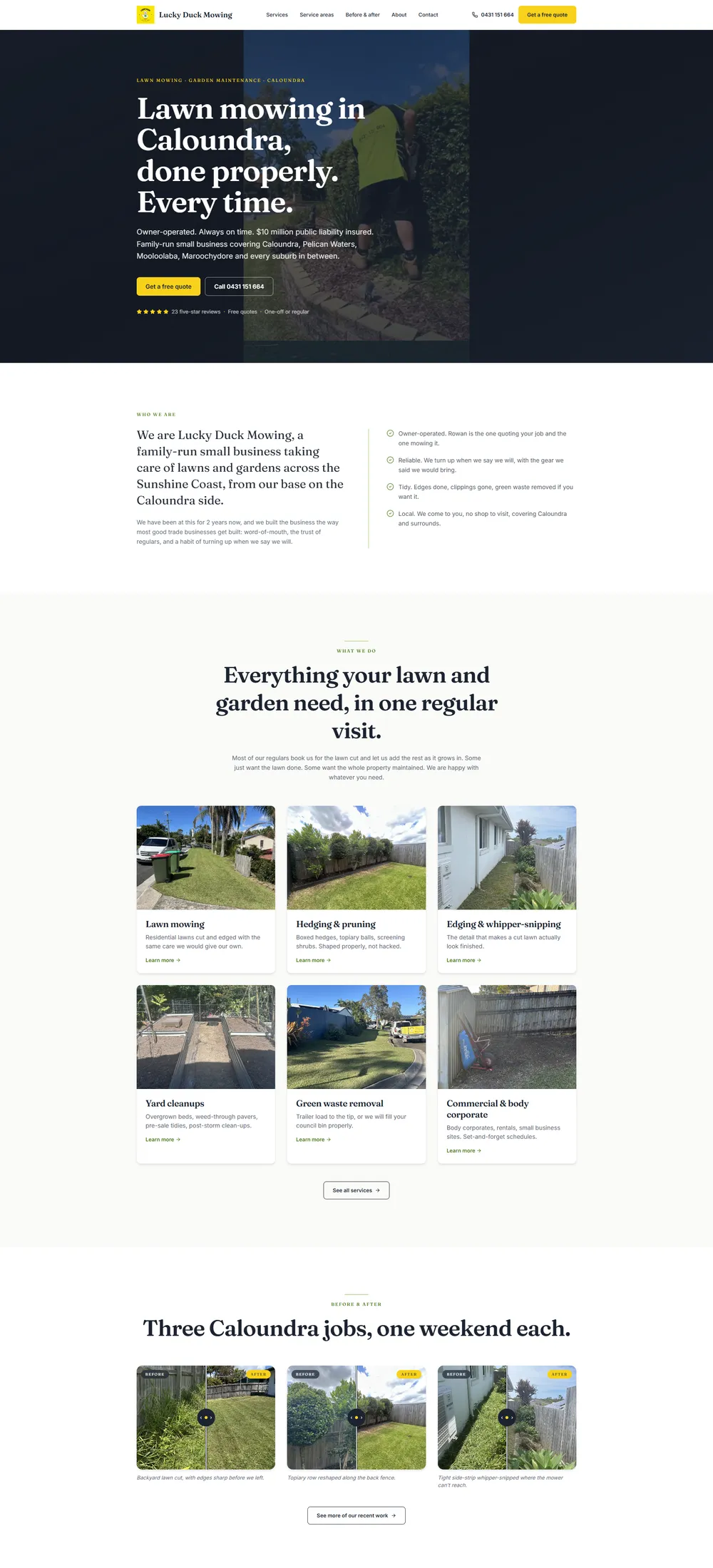
Pour both onto one page and it converts neither. The maintenance customer scrolls past a rendered courtyard hunting for a price and gives up. The design customer reads a per-visit mowing rate and quietly files you as a mowing outfit, which is a fine thing to be and a terrible thing to be mistaken for when a full backyard build is on the table. The fix is structural rather than cosmetic: separate landing points, separate forms, separate proof. Yardner in Adelaide leads with built work at full width, because looking is the first step of that sale. Lucky Duck Mowing does the reverse and puts the suburb and the service straight into the title tag, because that buyer is already reaching for the phone.
The spring rush is won in the quiet months.
Demand in this trade is set by weather rather than by budget cycles. Growth takes off after the first warm rain and the September to December stretch is a scramble. Hedging and tidy-ups spike in the fortnight before Christmas because people want the yard right for visitors. A hot dry January turns the searching towards irrigation, turf repair and anything that stops a lawn dying. Then it goes quiet, and a wet week can wipe out a fortnight of scheduled visits and push the whole run sideways.
The trap is that most landscapers go looking for a website in October, when the phone has already started and there is no spare hour to answer intake questions. Search does not run on that timeline. A page published in October spends the peak being crawled, assessed and slowly trusted, and by the time it carries any weight the season it was meant to catch has passed. The pages that take a spring rush were published and settled well before the grass moved.
That is the argument for building in the flat part of the year, and it is also the argument for what belongs on the site. Seasonal pages should sit there all year: winter pruning, autumn lawn preparation, pre-summer irrigation checks, storm clean-up after a big blow. Publishing a storm clean-up page the morning after a storm is too late for that storm and about right for the next one. Better dormant in July than rushed in November.
A round is worth more than a job.
An end-of-lease garden tidy is a few hours of work and then it is over. A fortnightly lawn that stays on the run for 3 years is a different business, and the gap widens because a full round is also a tight one: 6 lawns in a single street beats 6 lawns spread across the metro area, on fuel, on travel time and on how many visits fit in a day. Most lawn care websites are still written as though every visit is a one-off.
Selling a relationship changes what the page has to say. Frequency belongs on the page as a visible choice: weekly, fortnightly, monthly, or a one-off with the option to keep going. So does the ordinary detail nobody publishes, because that is what a maintenance customer is actually deciding on. What happens to the clippings. Whether you still come when it has rained. Whether they need to be home. Whether the side gate can be left unlocked for you. Whether the invoice turns up monthly by email. People stay with a maintenance business because they stop having to think about it, so the page has to sound like not having to think about it.
It changes what the site should capture too. An enquiry that records the suburb, the frequency and the rough yard size is a route-planning decision rather than just a lead. When 4 requests land from the same pocket of streets, that is the beginning of a new run. Writing the pages around the areas where you already hold a round is how the next ones arrive close together instead of scattered across the map.
Before and after does more work here than in any other trade.
Most trades finish with their work invisible. A rewired switchboard, a repaired pipe, a repainted ceiling: the customer has to take somebody's word for the difference. Landscaping is the exception. The change is total, it is visual, and a stranger can see the exact outcome they are hoping for standing in a yard shaped roughly like theirs.
That is why a before and after set beats any paragraph about quality, and it is also why it has to be shot properly to land. Stand in the same spot for both frames. Shoot at a similar time of day so the light does not do the arguing for you. Keep a fixed reference in shot, a fence line or a back door, so the eye locks the 2 images together. Take the before photo before the trailer is unloaded, because that is the one everybody forgets and it is the one that carries the pair. Phone photos are fine here. Honest beats polished.
Caption them the way a customer would describe the problem rather than the way you would invoice it: the grass that had taken over, the slope that got levelled and turfed, the bank that stopped washing out, and the suburb each one happened in. That way somebody scrolling can find their own yard in your work. A page carrying 12 real pairs outperforms a page carrying a testimonial and a stock photograph of a wheelbarrow. Send whatever you have from the last 2 years and the strongest pairs go highest on the page.
The quote form decides whether you drive out for nothing.
Landscaping is one of the few trades where a vague enquiry costs a whole morning. Nobody can price a paved area from one sentence, and nobody can mow a yard the machine cannot get into. So the form has to do some qualifying before you are in the ute with the trailer on.
For maintenance the useful fields are few and blunt: suburb, rough yard size, how often they want it, whether there is side access and how wide the gate is, and whether anything needs taking away. Lucky Duck Mowing gets enquiries that name the suburb, describe the property and give the size, which is enough to quote a regular lawn without a site visit at all.
Design and construction needs an entirely different set of questions: what the space gets used for now, what they want to do out there, whether there is a slope or a drainage problem, whether a retaining wall might need council approval, and a budget range they are willing to put in writing. That budget field worries people who think it will cost them leads. It costs them the wrong leads, which is the whole point when measuring up and pricing a scaled job burns half a day.
Both forms should land as a plain email on your phone with every field visible in it, so you can read the job at the lights and ring back from the next driveway rather than logging in somewhere to find out what the enquiry even was.
Both sides of the trade, both live, both open to inspection.
The Adelaide build is garden design and construction. The Sunshine Coast build is lawn maintenance. That is 2 landscaping builds, which is a small sample, and we would rather say so than pad this page out with logos from other trades. Open either one and read the monospace line under it: that is the actual title tag the site serves, which is the strongest single on-page signal for what a page can rank for.
A lawn quote request, straight off the form.
No mystery, no portal logins. The site's contact form emails the lead straight to you in plain English. Every field a tradie or service business needs to call back the same day.
- Name, email, phone in the first three lines
- Suburb (so you know if it's in your service area)
- The exact service they want and the page they came from
- Their full message in their own words
Reply directly from your inbox. Nothing to learn, no app to install.

Not just prettier. Built to be found.
Every rebuild leads with the client's main commercial keyword in the page title and a single clean H1. Design that looks the part, architecture that ranks on Google.
What happens if the growing season comes and nothing arrives.
No leads from SEO in your first 90 days and you stop paying until one arrives.
Given how this trade moves, that 90 days matters more than it looks. If a build lands in the middle of winter, the guarantee sits over the run-up to the season rather than over the season itself, so the site has to earn its keep before the grass does the selling for it.
The full wording, including what counts as a qualified lead and what we deliberately do not promise, is on the guarantee page. There is a longer write-up of the Sunshine Coast build on the Lucky Duck Mowing case study, and the wider trade picture sits on websites for tradies.
One plan. All inclusive. $0 to start.
The $297/month subscription is the all-inclusive monthly retainer that keeps your site working long after the build is done. Hosting, backups, and any website changes you need (swap an image, edit some copy, add a page), with a direct line to Chris. First payment only triggers once the site is live and tracking is confirmed.
- Free website, built in 5 working days
- No lead in 90 days and you stop paying until one arrives, in writing
- Built SEO-ready: keyword-aligned pages, schema, fast hosting
- Hosting served from Sydney, with daily backups
- Ongoing website changes: swap an image, edit copy, add a page
- Client portal: request changes, made within 3 business days
- A direct line to Chris and a single point of contact
- You own the website, the domain and the code
- 12-month subscription, then continue or cancel with 30 days notice
- Google Ads management available as an add-on
If you are weighing up doing it yourself.
What landscapers and mowing operators ask us.
On the same site, yes. On the same page, no. They are 2 different buyers with different urgency and different budgets, so each gets its own landing point, its own enquiry form and its own proof. Sharing one page tends to convert neither of them.
The quiet stretch, so the pages are published and settled before growth takes off. Building during the spring peak means the site spends the busiest months getting assessed by Google, and you have no spare time to answer intake questions anyway.
Send everything you have and we will use the strongest pairs. About 12 genuine pairs will carry the site. If you only have afters, start taking the before shot on the next job, before the trailer comes off the tow ball, because that frame is what makes the pair work.
Yes. Frequency, suburb, rough yard size, gate access and green waste removal can all be fields on the maintenance form, and they arrive in the email with the enquiry. Design and construction gets a separate form with scope and budget questions instead.
It is, because a round compounds. One customer who stays on a fortnightly run for years is worth far more than the job that started it, and their neighbours tend to ask who does the lawn. A site also lets you aim at the suburbs where your run already is.
Only the ones you can write honestly about and would genuinely drive to. Mass-produced suburb pages get treated as scaled content abuse and quietly ignored, and they pull in enquiries from 40 minutes away that wreck a day of routing.
That is when pruning, garden clean-ups, mulching, turf preparation and irrigation planning get searched. Those pages exist on the site year round, so the quiet months carry some work and the site is already established when growth returns.
No leads from SEO in your first 90 days and you stop paying until one arrives. Billing resumes on the first qualified lead, which means a unique inbound call of 60 seconds or longer, or a completed quote form. There is no refund, and we do not promise a ranking or a date.
We take 4 builds a month. Slots open now: 3.
Tell us which side of the trade you want more of, the suburbs your run already covers, and whether you have before and after photos sitting on your phone. We reply in writing, and everything after that runs by email and through the client portal.