Websites for NDIS providers, built for the person checking your credentials.
Nothing to pay before launch. Once the site is live it is $297 a month including GST for 12 months, which comes to $3,564, and the first invoice waits until tracking is verified.
What should an NDIS provider website include?
The person reading your website is usually not the participant.
Almost every other business on this site writes for the person who pays. You do not. Your traffic is dominated by people assessing you on somebody else's behalf, under time pressure, against a list.
The support coordinator with a shortlist
She is matching plans to providers, often several at once, and her first task is elimination. Do you take this plan management type, do you drive to this town, do you have capacity, do you hold the registration group.
The parent handed your name
Referrals still travel by word of mouth here, so much of your traffic is somebody typing your business name to check a recommendation. That search has to land on a page that confirms you, not a stale directory profile.
The plan manager checking the basics
They want your ABN, registration status, invoicing details and a contact route that is not a personal mobile. Dull information, and it decides whether the referral proceeds.
The OT or psychologist referring on
An allied health professional referring out is putting their own judgement behind you, so they read the practitioner bio first: qualifications, memberships, supervision, the populations you work with.
None of them are moved by a hero photograph and the words person-centred, holistic support. Every provider writes that sentence, which is why it stopped meaning anything.
Registration details, and the 2 ways people search for them.
A coordinator searches in funding language: specialist behaviour support, assistance with self-care, the registration group name. A parent searches in kitchen-table language: help for a son who melts down at school, someone to get mum to appointments. Neither will find the other's page.
So each support gets a page that opens in plain words, describes what happens in an actual session or visit, then names the funding category underneath, where a coordinator can match it to a line in the plan.
Under that sits the credential block, in text a reader can select, a screen reader can announce and a crawler can index: registration status, registration number, the groups you hold, the practitioner doing the work, their qualifications and memberships. Advanced Behaviour Support Services puts its number, its region list and its AASW membership exactly where a coordinator goes looking.
Not registered? Say so as plainly, and say which plan management types you take. An agency-managed enquiry you cannot accept costs a family a week. Your own position is worth confirming with the Commission rather than with me.
On a disability services site, the accessibility tree is the conversion path.
Elsewhere this is a compliance chore bolted on last. Here a meaningful share of readers use a screen reader, magnification, keyboard-only navigation, or read slowly because of an intellectual or cognitive disability. The accessibility tree is what a screen reader announces, and close to the structure a crawler reads. Break it and you lose the reader and the ranking together.
Headings that are actually headings
Screen reader users navigate by jumping between headings, so a line that is merely bold is invisible to them and meaningless to a crawler.
Labels that stay put
A placeholder that vanishes the moment typing starts is a memory test, and a hard one for a reader with a cognitive disability. Labels stay visible.
Keyboard focus you can see
Plenty of your readers never touch a mouse. Tabbing has to show a clear focus ring at every step, and a skip link has to bypass the navigation.
Contrast, reflow and zoom
Pale grey on white looks refined on a designer's monitor and disappears on a phone in a carpark. Text has to reflow at 200% zoom without a sideways scrollbar.
Nothing that moves on its own
Auto-advancing carousels and looping background video are hostile to vestibular conditions and to anyone who needs longer to read a line. Motion stops on request.
Plain language ahead of funding language
Short sentences carrying a single idea, the everyday word before the funding word, acronyms spelled out once. Plain sentence first, terminology underneath.
That is how I build, not an upgrade. What I will not hand you is a conformance certificate. A formal audit, tested with people with disability rather than software alone, is its own piece of work.
Travel is billable, so your service regions are a costing decision.
On a trade website the service area page is a search habit. In disability supports it is arithmetic. Provider travel is claimable under the pricing arrangements within set limits, so the distance between your practitioner and a participant's front door comes out of somebody's plan. A referral from a town 2 hours away is not automatically good work.
Advanced Behaviour Support Services covers Adelaide, the Barossa, the Mid North and the Yorke Peninsula: 4 separate catchments rather than a radius drawn around a CBD office. Somebody in Clare or Kadina does not call themselves greater Adelaide and does not type it, so a single metro page would never reach them.
What works is a page per region you genuinely travel to, written about the travel: how far the drive is, which days you are out that way, whether a school visit and a home visit fit into one trip. That cannot be templated, which is why it ranks. What fails is 200 near-identical suburb pages, treated as scaled content abuse and answered by people you would never drive to. Say what happens at the edges too: refer onward, offer telehealth, or quote travel in advance.
What I will not write on an NDIS provider website.
Copy that is ordinary on a plumbing site is not acceptable here. The NDIS Code of Conduct reaches the claims a provider makes about its services, and the Commission publishes guidance on advertising. So a short list of sentences never goes on the page.
- Outcome promises about a participant, in any wording: improvement, progress, results.
- Superlatives nobody can evidence: best, leading, most trusted, number 1 provider in town.
- A registration claim without the registration number and groups, supplied by you.
- Testimonials that could identify a participant, their family or their circumstances.
- Clinical claims about a support, unless you give me a source I can put on the page.
What goes on instead is verifiable: what you do, who does it, where you travel, which participants you can take. The boundary matters as well. My work is the website and the search results. Your registration, your advertising obligations and anything touching restrictive practices sit with you and the NDIS Quality and Safeguards Commission, and I will tell you to check rather than guess.
The same restraint runs back the other way, which is why I will not tell you where you will rank or when.
If your website has not produced a lead from SEO within the first 90 days, you stop paying me until it does. There is no refund, and I do not promise rankings.
Counting as a qualified lead: a unique inbound call of 60 seconds or more, or a completed contact or referral form. Not counting: colleagues, participants you already support, suppliers, sales calls, spam or paid-ads traffic.
Read the full guaranteeOne NDIS build on this offer, and you can check every claim on it.
Honest disclosure before you scroll: there is 1 disability services build running on this offer, not a dozen. Advanced Behaviour Support Services is a registered provider covering 4 South Australian regions. Open the card, read the title tag underneath, then go looking for the registration number and see how long it takes you.
Not just prettier. Built to be found.
Every rebuild leads with the client's main commercial keyword in the page title and a single clean H1. Design that looks the part, architecture that ranks on Google.
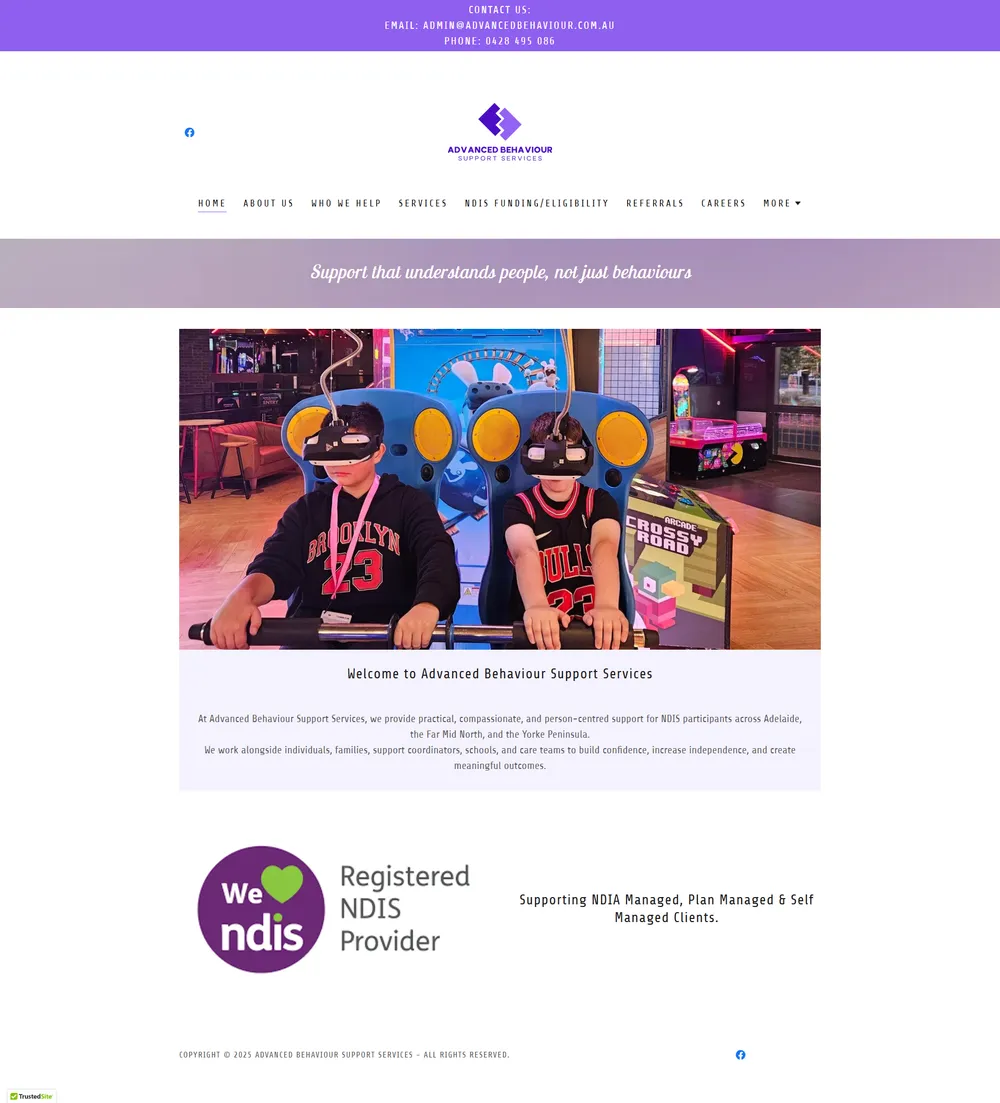
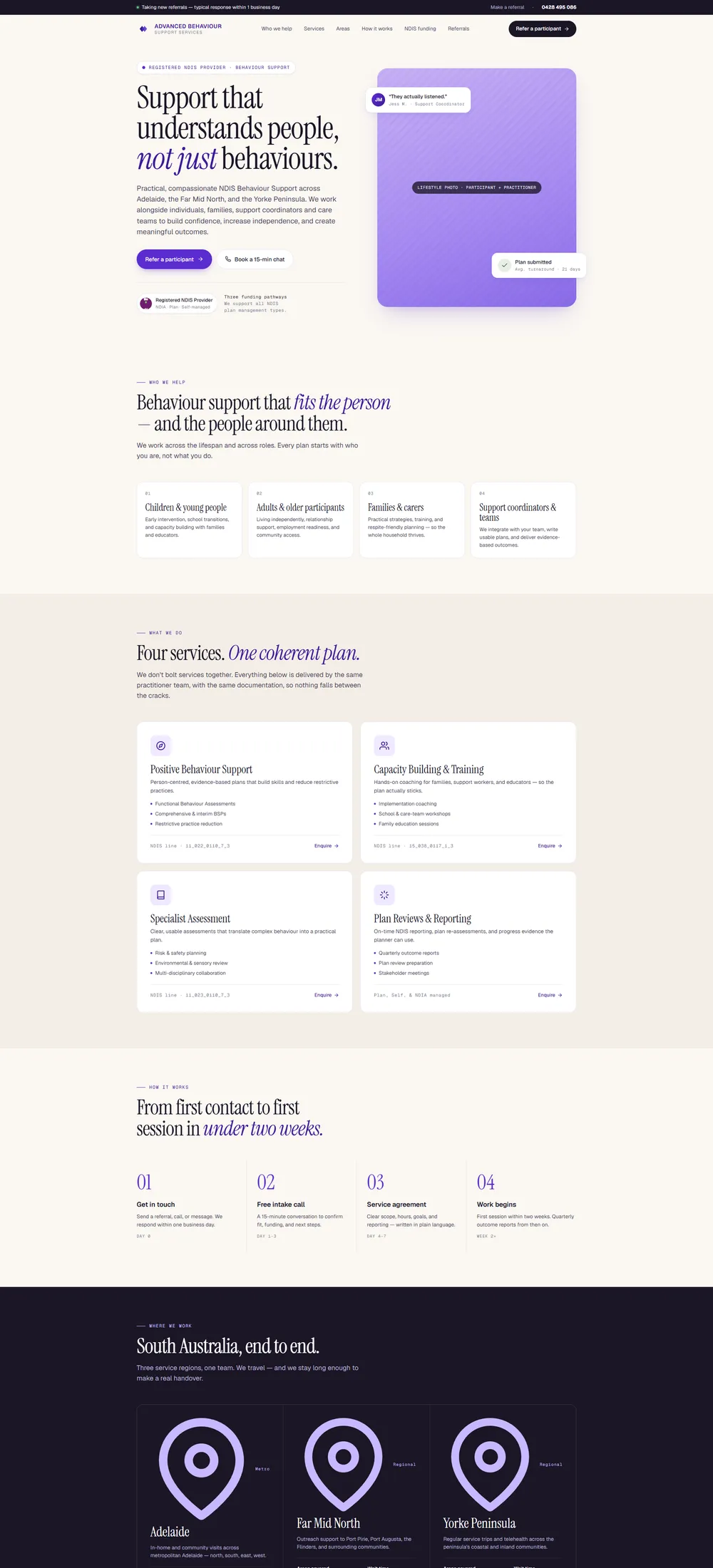
Why there is no screenshot of a referral email on this page.
Other pages here publish a real lead email with the contact details blacked out, because a quote for a lawn or a pool is not sensitive. A referral to a disability support provider is. It can carry a participant's name, how their plan is managed and why support is being sought, which is health information about somebody who never agreed to appear in marketing. Redact it until publishing is safe and an empty rectangle is what is left. Read that as the standard applied to your enquiries: referrals arriving through your site stay yours.
1 plan. $0 to start. Yours to keep.
The $297/month subscription is the all-inclusive monthly retainer that keeps your site working long after the build is done. Hosting, backups, and any website changes you need (swap an image, edit some copy, add a page), with a direct line to Chris. First payment only triggers once the site is live and tracking is confirmed.
The site, the domain and the code belong to you from day 1. After the 12th payment your website is paid off, and you choose: keep your plan at $297 a month for website changes and a quarterly SEO review, or cancel, and I'll either keep hosting your site for free or hand you the full code to host wherever you like.
- Free website, built in 5 working days
- No leads from SEO in your first 90 days and you stop paying until one arrives.
- Built SEO-ready: keyword-aligned pages, schema, fast hosting
- Hosting served from Sydney, with daily backups
- Ongoing website changes: swap an image, edit copy, add a page
- Client portal: request changes, made within 3 business days
- A direct line to Chris and a single point of contact
- Paid for in full by 12 payments, then it's yours to keep
- Google Ads management available as an add-on
Worth reading if you are weighing up the build.
What providers ask before a referral form goes near a website.
As selectable text near your practitioner details, and again in the footer. Not inside a scanned certificate and not in a PDF, because neither can be copied, searched or read aloud by a screen reader.
Yes, and it matters more. Plan-managed and self-managed participants are generally free to choose unregistered providers, so say plainly which plan management types you take. Confirm your own position with the NDIS Commission.
I build with the patterns above as standard: semantic headings, labelled fields, visible focus, sound contrast, alt text. I do not sell a conformance certificate, and a formal audit is a separate exercise.
I structure each service page so a plain-language summary sits at the top, and I will host and link an Easy Read document you supply. Producing genuine Easy Read is its own discipline, usually done alongside people with intellectual disability.
The minimum needed to make contact and route the enquiry: a name, a contact method, the region, the support area, and how the plan is managed. No NDIS numbers, no diagnoses. Clinical detail belongs in your own secure intake.
Yes, and keep it current. Capacity is the second question every coordinator asks and the one that wastes the most time unanswered. Marking a region open, waitlisted or closed spares you enquiries you cannot serve.
I take 4 builds a month. Slots open now: 3.
Tell me your registration status, the regions you travel to and the supports you have capacity for right now. I reply in writing, and everything after that runs by email and through the client portal.